Physical Address
304 North Cardinal St.
Dorchester Center, MA 02124
Physical Address
304 North Cardinal St.
Dorchester Center, MA 02124
Author: Paulo Coelho
Genre: Self-Help / Philosophical Fiction
Originally Published: 1988
In a world where most people abandon their dreams for the comfort of routine, Paulo Coelho’s The Alchemist remains a timeless guide to following your purpose. First published over three decades ago, this allegorical novel has sold more than 150 million copies worldwide and continues to inspire readers searching for meaning in their lives.
Whether you’re at a career crossroads, feeling stuck in monotony, or questioning your life’s direction, The Alchemist offers profound wisdom wrapped in a simple story. This summary breaks down the key lessons from the book, exploring why a tale about a shepherd boy searching for treasure resonates so deeply with modern readers facing burnout, uncertainty, and the pressure to conform.
If you’re searching for “The Alchemist summary” or “key lessons from The Alchemist,” this guide will walk you through the book’s core ideas, practical takeaways, and how its ancient wisdom applies to your life today. By the end, you’ll understand why this book has become a spiritual handbook for dreamers, entrepreneurs, and anyone brave enough to pursue their Personal Legend.
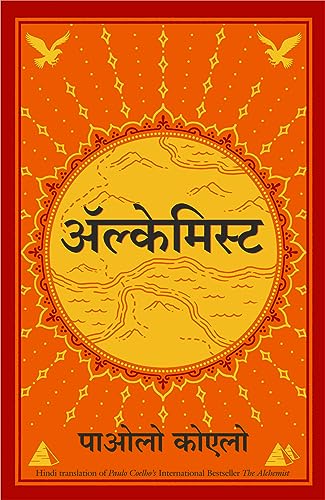

Paulo Coelho is a Brazilian author and one of the most widely read writers in the world. Before achieving literary success, Coelho lived a rebellious youth—he was institutionalized by his parents, worked as a theater director, and traveled extensively as a hippie in the 1960s and 70s. These experiences deeply shaped his spiritual worldview.
After a transformative pilgrimage on the Camino de Santiago in 1986, Coelho felt called to write. The Alchemist, his second book, became an international phenomenon despite initial rejection by publishers. His work blends spirituality, philosophy, and storytelling, drawing from Christianity, Islam, Judaism, and universal spiritual traditions. Today, Coelho’s books have been translated into over 80 languages, and he’s recognized as a spiritual thought leader whose words inspire millions to follow their dreams despite fear and doubt.
The Alchemist tells the story of Santiago, an Andalusian shepherd boy who dreams of finding treasure near the Egyptian pyramids. Taking this recurring dream seriously, he sells his flock and embarks on a journey across Morocco and the Sahara Desert, encountering mentors, setbacks, love, and life-changing lessons along the way.
At its core, the book is an allegory about pursuing your Personal Legend—your unique purpose or calling in life. Through Santiago’s journey, Coelho explores themes of destiny, intuition, perseverance, and the idea that the universe conspires to help those who pursue their dreams with courage. The treasure Santiago seeks becomes a metaphor for self-discovery, showing that the real reward isn’t just the destination but the transformation that happens along the way. This philosophical fable challenges readers to listen to their hearts, embrace uncertainty, and trust that following your passion is never a wasted journey.
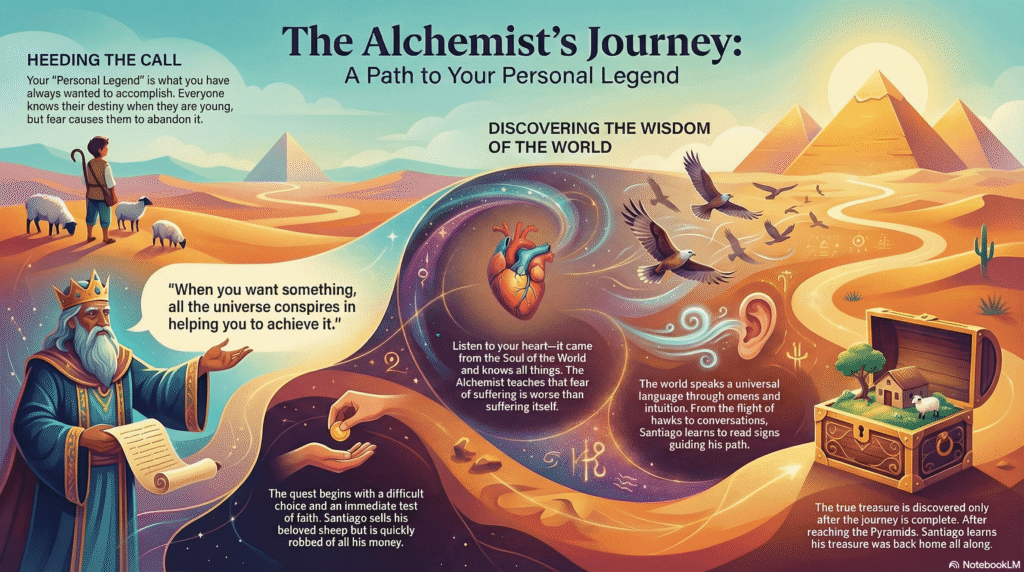
The most fundamental concept in The Alchemist is the Personal Legend—your life’s true purpose or calling. Coelho argues that every person is born with a unique dream or destiny, but most people abandon it due to fear, societal pressure, or comfort.
Santiago’s journey begins when he takes his recurring dream seriously instead of dismissing it. In our modern world, this translates to listening to that persistent voice telling you to start a business, change careers, create art, or pursue a passion you’ve been ignoring. The book suggests that when you’re young, you know what your Personal Legend is, but as you grow older, you’re conditioned to ignore it.
Why it matters: Most people live with regret because they never tried. Identifying and pursuing your Personal Legend is presented as the key to a fulfilling life, even if the path is uncertain.
One of the most quoted ideas from The Alchemist is that when you commit to your dream, the universe aligns to support you. This isn’t magical thinking—it’s about how focus and determination open your awareness to opportunities you’d otherwise miss.
Santiago experiences this repeatedly: he meets the right people at the right time, learns necessary skills, and receives help when most needed. In real life, this principle shows up when you take action toward a goal and suddenly notice relevant resources, connections, or ideas that were always there but invisible until you committed.
Modern example: When you decide to change careers, you suddenly notice job postings, meet people in that industry, or stumble upon a course that teaches exactly what you need. The resources were always available, but your commitment activated your awareness.
Throughout the book, Santiago faces fear—fear of failure, loss, the unknown, and even success. Coelho identifies fear as the primary reason people abandon their Personal Legend. The book distinguishes between rational caution and the paralyzing fear that keeps you trapped.
The old king Melchizedek tells Santiago that when you’re close to realizing your dream, fear intensifies. This is the “darkest hour before dawn” phenomenon. Many people quit right before their breakthrough because the fear becomes unbearable.
Why it matters: Recognizing that fear is a natural part of pursuing meaningful goals helps you push through instead of seeing it as a sign to quit. The book normalizes fear while emphasizing that courage isn’t the absence of fear—it’s moving forward despite it.
Coelho introduces the concept of “omens”—signs from the universe guiding you toward your destiny. While this sounds mystical, it’s really about developing intuition and paying attention to synchronicities, gut feelings, and patterns.
Santiago learns to trust his heart and recognize omens through his journey. In practical terms, this means noticing when opportunities repeatedly present themselves, when certain people keep appearing in your life, or when your gut consistently tells you something feels right or wrong.
Real-life application: Successful entrepreneurs often talk about “trusting their gut” when making decisions. This isn’t luck—it’s pattern recognition and intuition developed through experience and attention.
In a powerful twist, Santiago discovers that the treasure he traveled so far to find was actually buried back home, beneath the tree where his journey began. This teaches that you often already have what you need, but the journey of seeking transforms you into someone capable of recognizing and claiming it.
This isn’t about the destination being pointless—Santiago couldn’t have found the treasure without making the journey. The experiences, wisdom, and growth he gained were necessary to understand the treasure’s true value.
Modern interpretation: Sometimes you leave a job, relationship, or city searching for something better, only to return later and see it with new eyes. The journey changed you, making you capable of appreciating what was always there.
Santiago learns that his heart knows his true path, but he must learn to listen to it. The book emphasizes that your heart will always point you toward your Personal Legend, even when logic or other people’s opinions suggest otherwise.
However, Coelho is nuanced here—listening to your heart doesn’t mean being reckless. It means distinguishing between your authentic desires and fear-based reactions or external expectations.
Why it matters: In a world full of advice, opinions, and social media pressure, learning to hear your own inner voice becomes a survival skill for maintaining authenticity and purpose.
Through the alchemist character, Santiago learns about “maktub”—an Arabic word meaning “it is written.” This philosophy combines destiny with presence, suggesting that while your path unfolds as it should, you must stay fully present to recognize opportunities and lessons.
The book teaches that worry about the future or regret about the past pulls you away from where life actually happens—right now. Santiago must learn to be present in the desert, with Fatima, and in every moment of his journey.
Practical wisdom: Anxiety often comes from living in the future (worry) or past (regret). Focusing on what you can do today with what you have right now creates both peace and progress.
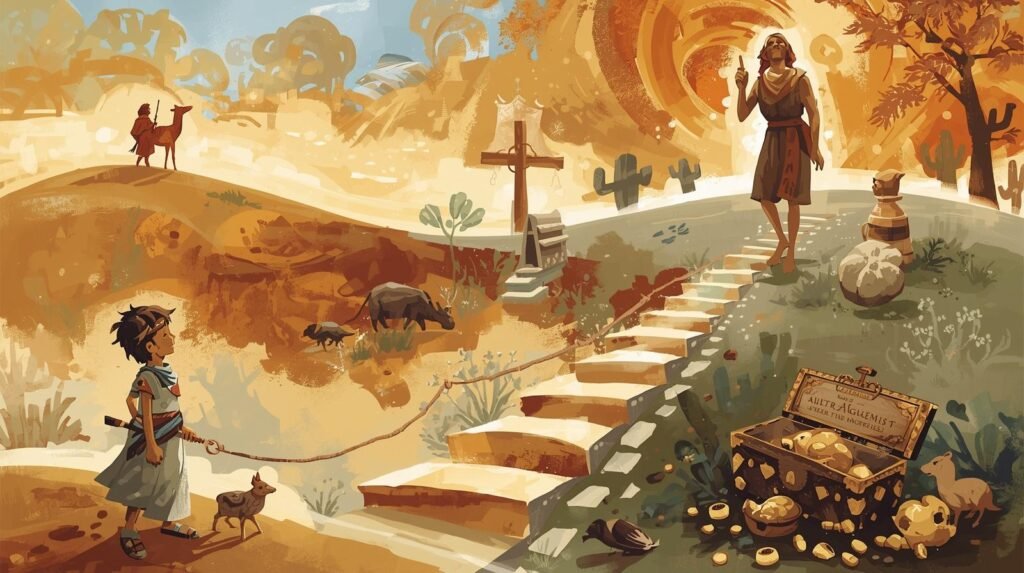
“And, when you want something, all the universe conspires in helping you to achieve it.”
This central theme reminds us that commitment and action create momentum and opportunities.
“The secret of life, though, is to fall seven times and to get up eight times.”
Resilience and persistence matter more than never failing.
“People are capable, at any time in their lives, of doing what they dream of.”
It’s never too late to pursue what matters to you.
“There is only one thing that makes a dream impossible to achieve: the fear of failure.”
Fear, not circumstances, is usually the real obstacle.
“When we strive to become better than we are, everything around us becomes better too.”
Personal growth creates a ripple effect in your environment and relationships.
The Alchemist is perfect for anyone feeling stuck, unfulfilled, or questioning their life’s direction. If you’re at a crossroads—considering a career change, contemplating a big move, or wondering if there’s more to life—this book offers both inspiration and philosophical guidance. It resonates particularly with dreamers, creative professionals, entrepreneurs, and anyone who suspects they’ve been living someone else’s vision rather than their own. Young adults searching for purpose and mid-life individuals reassessing their path will both find value in Santiago’s journey. It’s also ideal for readers who appreciate spiritual wisdom without strict religious doctrine.
Readers seeking concrete, tactical advice may find the allegorical storytelling too abstract. If you prefer dense, evidence-based self-help with specific systems and frameworks, the philosophical nature of The Alchemist might feel too simplistic or “woo-woo.” The writing style is deliberately simple, almost fable-like, which some literary readers find too basic. Additionally, if you’re skeptical about concepts like destiny, universal energy, or spiritual guidance, the book’s core philosophy may not resonate. It requires a willingness to engage with metaphor and symbolism rather than literal instruction.
The Alchemist ultimately teaches that pursuing your unique purpose—your Personal Legend—is life’s most important journey. The treasure you seek isn’t just external success or achievement; it’s becoming the person capable of recognizing and appreciating what truly matters. Coelho’s story reminds us that fear will always be present, but courage comes from moving forward anyway. The universe does support those who commit to meaningful dreams, not through magic, but through the opportunities and growth that appear when you’re truly paying attention.
The single strongest takeaway: Stop waiting for the perfect time, for fear to disappear, or for permission to pursue what matters to you. Start now, trust the journey, and know that the lessons learned along the way are just as valuable as reaching your destination. Your Personal Legend is calling—the only question is whether you’ll answer.
What is the main idea of The Alchemist?
The main idea is that everyone has a Personal Legend (unique purpose), and when you pursue it with courage and commitment, the universe conspires to help you achieve it. The journey of pursuing your dreams transforms you.
Is The Alchemist worth reading?
Yes, especially if you’re seeking inspiration, questioning your life direction, or need encouragement to pursue a dream. While simple in style, its philosophical depth has resonated with millions worldwide for over 30 years.
Who should read this book?
Anyone at a crossroads, feeling unfulfilled, or contemplating a major life change. It’s ideal for dreamers, entrepreneurs, creative professionals, and anyone who believes there’s more to life than their current path.
What does Personal Legend mean in The Alchemist?
Your Personal Legend is your true calling or purpose in life—what you feel deeply drawn to do or become. It’s the dream you’re born with that often gets buried by fear and societal expectations.
Is The Alchemist based on a true story?
No, it’s an allegorical novel, though Coelho drew inspiration from his own spiritual journey, including his pilgrimage on the Camino de Santiago, which transformed his perspective on destiny and purpose.
Ready to experience Santiago’s journey for yourself? The Alchemist is widely available in multiple formats to suit your reading preference:
Paperback/Hardcover: Available at major bookstores and online retailers like Amazon. The physical book makes a great gift for someone at a life crossroads.
Kindle/E-book: Perfect for digital readers who want instant access and the ability to highlight key passages.
Audible/Audiobook: Narrated beautifully, this format works well for the book’s storytelling style. Great for commutes or while traveling—fitting since the book is about a journey.
Whether you’re reading it for the first time or returning to it years later with new life experience, The Alchemist offers timeless wisdom that speaks differently depending on where you are in your own journey. The right time to start is now—your Personal Legend is waiting.