Physical Address
304 North Cardinal St.
Dorchester Center, MA 02124
Physical Address
304 North Cardinal St.
Dorchester Center, MA 02124
Power shapes relationships, decisions and outcomes in every area of life. Some people understand it and rise. Others ignore it and get sidelined. Robert Greene’s The 48 Laws of Power explores these dynamics through history, psychology and strategy.
This summary breaks down each major idea in simple, practical language so you can understand how power works, when to apply it and when to avoid it.
Robert Greene is an American author known for writing about strategy, human behavior and social influence. He has studied historical leaders, military figures and thinkers from different cultures. His work combines research with real examples, making his books popular among entrepreneurs, artists, athletes and world leaders.
His other well-known titles include The 33 Strategies of War, The Art of Seduction and Mastery.
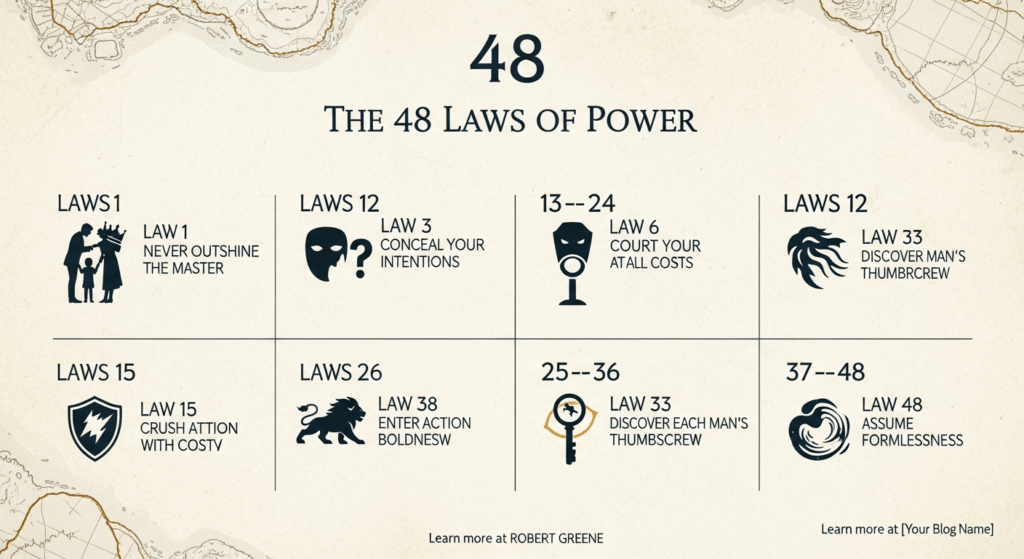
The 48 Laws of Power explains how people gain, maintain or lose power. Greene draws from the lives of kings, generals, politicians and philosophers to illustrate each law.
The book is structured into 48 lessons, each focused on a rule, strategy or warning. Some laws teach how to rise quietly. Others teach how to defend yourself against manipulation.
The central theme is simple: Power is always present. You can either learn to navigate it or be controlled by those who do.
The acquisition of power is presented as an inescapable, fundamental game of social interaction. The feeling of having no power over people and events is unbearable, motivating everyone to seek more power. To succeed in the modern world, one must be subtle, congenial, yet cunning, democratic, yet devious, often requiring the use of an “iron hand inside a velvet glove”.
The approach to power is essentially amoral; success depends on focusing on results and circumstances rather than judging actions as inherently good or evil. Since most people attempt to mask their power plays, true mastery requires recognizing deceit and manipulation in others.
The supreme skill needed is the ability to master your emotions, as emotional responses like anger cloud reason and cost more than any temporary satisfaction gained from expression.
Patience, similarly, is vital as it prevents “moronic blunders” and is the “supreme virtue” in the acquisition of power. One must also accept that deception and masquerade—wearing many masks and concealing intentions—are necessary skills for success.
Individuals who feign disinterest in power often use cunning methods themselves, such as displaying weakness (Law 22) or masking self-interest with demands for perfect honesty or equality.
The superior individual learns to excel at the game, mastering the arts of seduction, charm, deception, and subtle strategy by observing people’s hidden motives, which provides endless opportunities for manipulation.
The sources provide the framework for nearly all 48 laws of power, outlining specific strategies for gaining, consolidating, and maintaining power.
Several laws focus on managing how you are perceived, as appearances are the cornerstone of power.
• Law 1: Never Outshine the Master requires subordinates to always make those above them feel comfortably superior, making the master appear more brilliant to attain the heights of power. Nicolas Fouquet, for instance, inspired fear and insecurity in Louis XIV by hosting a spectacular party that inadvertently flaunted his own wealth and popularity, leading to his ruin.
• Law 3: Conceal Your Intentions dictates that revealing your purpose allows others to prepare a defense. Instead, keep people off-balance by enveloping them in enough “smoke” or guiding them down a false path until it is too late for them to realize your true aims. Bismarck successfully concealed his true intention—war with Austria—by publicly advocating for peace, leading the King to trust and promote him.
• Law 4: Always Say Less Than Necessary is employed because powerful people impress and intimidate by saying less. Speaking vaguely or sphinxlike gives an air of control and originality, minimizing the chance of saying something foolish. Louis XIV famously maintained control by using short, enigmatic phrases like “I shall see,” forcing others to nervously fill the silence and reveal themselves.
• Law 5: So Much Depends on Reputation—Guard It with Your Life emphasizes reputation as the cornerstone of power, through which one can intimidate and win. Reputation must be made “unassailable,” and one must be ready to destroy the reputations of enemies. The Chinese general Chuko Liang cultivated a reputation for cunning that intimidated enemies into retreating without a fight.
• Law 6: Court Attention at All Cost advises standing out and being conspicuous, making oneself a magnet of attention. Showman P. T. Barnum understood that the quality of attention is irrelevant; notorious or sensational images prevent one from being “buried in oblivion”.
• Law 17: Keep Others in Suspended Terror: Cultivate an Air of Unpredictability turns the tables on humans’ need for familiarity by making behavior seem inconsistent or purposeless. This keeps opponents off-balance; chess champion Bobby Fischer used seemingly random moves and calculated delays to unnerve his highly predictable opponent, Boris Spassky.
• Law 25: Re-Create Yourself encourages forging a new, dramatic identity that commands attention rather than accepting roles society attempts to impose. This enhances one’s power and makes one’s character seem larger than life, as demonstrated by George Sand’s male-like persona.
• Law 30: Make Your Accomplishments Seem Effortless dictates that all the toil, practice, and clever tricks must be concealed. Acting naturally and gracefully creates a “godlike” impression of effortless talent, whereas revealing hard work only raises questions.
These principles concern managing subordinates, rivals, friends, and enemies.
• Law 2: Never Put Too Much Trust in Friends, Learn How to Use Enemies. Friends are wary and easily aroused to envy, betraying you more quickly. Former enemies, however, are often more loyal because they have more to prove. Emperor Michael III’s trust in his friend Basilius proved fatal, as Basilius eventually betrayed and murdered him to seize power.
• Law 7: Get Others to Do the Work for You, But Always Take the Credit. Use the knowledge and labor of others to save time and energy, securing the credit for yourself. Nikola Tesla, despite his brilliance, failed to secure credit or wealth for his inventions, while businessmen like Thomas Edison, who hired others to do the difficult scientific work, gained fame and money.
• Law 10: Infection: Avoid the Unhappy and Unlucky. Emotional misery is infectious. Association with the unfortunate will draw misfortune onto you; associate instead with the happy and fortunate.
• Law 11: Learn to Keep People Dependent on You. Independence requires being constantly needed and wanted; the more relied upon you are, the more freedom you have. Never give people enough skill to do without you. Chancellor Bismarck achieved immense power by attaching himself to two weak Prussian kings, making them utterly dependent on his strength and intelligence.
• Law 13: When Asking for Help, Appeal to People’s Self-Interest, Never to Their Mercy or Gratitude. People primarily act based on self-interest. Highlighting the benefits they will gain from helping you is far more effective than reminding them of past favors, which they will easily ignore.
• Law 14: Pose as a Friend, Work as a Spy. Gather valuable information about rivals’ weaknesses and intentions by playing the spy yourself during polite social encounters.
• Law 19: Know Who You’re Dealing With—Do Not Offend the Wrong Person. Never assume everyone reacts the same way to strategy. Choose opponents and victims carefully; deceiving or offending the wrong person can lead to lifelong revenge.
• Law 20: Do Not Commit to Anyone. By remaining independent, you force others to pursue you, gaining the power to play people against each other. Commitment signals possession and loss of power. Queen Elizabeth I maintained her authority and independence by never marrying, keeping many domestic and foreign suitors vying for her hand.
• Law 26: Keep Your Hands Clean (see also Laws of Deception and Image) advises maintaining a spotless appearance by using scapegoats or “cat’s-paws” to absorb the blame for mistakes or perform necessary, unsavory tasks. Cesare Borgia used his lieutenant Remirro de Oreo to brutally restore order, then publicly executed de Oreo to deflect popular hatred from himself onto the scapegoat.
• Law 43: Work on the Hearts and Minds of Others. Seduce people into wanting to move in your direction, converting them into loyal pawns, by appealing to their individual psychologies, emotions, fears, and hopes. Coercion creates lasting resistance. Chuko Liang, rather than crushing the southern barbarians, released them seven times to win King Menghuo’s heart, gaining him a devoted ally.
These laws detail strategies for seizing the initiative, timing conflicts, and responding to resistance.
• Law 9: Win Through Your Actions, Never Through Argument. Argument sparks resentment and ill will; demonstration through action is far more powerful and prevents offense. Michelangelo convinced patron Piero Soderini that a flaw in the statue David‘s nose was fixed by pretending to chip stone dust while standing on scaffolding, appealing to the visual demonstration rather than argument.
• Law 12: Use Selective Honesty and Generosity to Disarm Your Victim. A gesture of sincerity or generosity drops the guard of even the most suspicious, allowing manipulation. The unexpectedness of the act is key. Con artist Count Victor Lustig returned Al Capone’s $50,000 intact after a failed scheme, shocking the gangster with the apparent honesty; Capone rewarded him with $5,000.
• Law 15: Crush Your Enemy Totally. Never stop halfway in conflict. Annihilation prevents the enemy from recovering and seeking revenge. Liu Pang learned this lesson, finally executing his enemy Hsiang Yu, which allowed him to found the long-lasting Han Dynasty.
• Law 22: Use the Surrender Tactic: Transform Weakness into Power (see also Philosophical Foundation).
• Law 23: Concentrate Your Forces (see also Laws Governing Relationships and Allies).
• Law 29: Plan All the Way to the End. Always think far ahead, taking into account all consequences and obstacles. Knowing the desired end goal prevents circumstances from overwhelming you and ensures you know when to stop. Bismarck achieved the unification of Germany by planning three wars in sequence, stopping immediately once the grand objective was reached, despite pressure to continue.
• Law 31: Control the Options: Get Others to Play with the Cards You Deal. Give people the illusion of choice between options, both of which serve your purpose. This makes them feel in control even when they are your puppets. Czar Ivan the Terrible, facing resistance, offered the country a “choice”: either his absolute rule or his permanent abdication and ensuing anarchy. The country chose absolute rule.
• Law 35: Master the Art of Timing. Patience is key to managing the long-term, waiting for the optimal moment to strike. Hurrying betrays a lack of control and compounds problems. Joseph Fouche successfully navigated the French Revolution by consistently recognizing and adapting to the “spirit of the times,” striking fiercely only when the moment reached fruition.
• Law 36: Disdain Things You Cannot Have: Ignoring Them Is the Best Revenge. Attention gives credibility to small problems or enemies. By ignoring irritations, you deny them existence and appear superior. King Henry VIII used total disdain against Pope Clement VII and Catherine of Aragon, forcing them to exhaust themselves in a “futile engagement” while he proceeded with his goals.
• Law 37: Create Compelling Spectacles (see also Laws Governing Reputation and Image).
• Law 39: Stir Up Waters to Catch Fish. Stay calm yourself, but provoke enemies into anger to put them off-balance, holding the strings. Napoleon’s public rant against Talleyrand, instigated by rumors, demonstrated Napoleon’s loss of control, while Talleyrand’s composure made the emperor look ridiculous—the result of Napoleon failing to control his own temper and being baited.
• Law 42: Strike the Shepherd and the Sheep Will Scatter. Neutralize influential troublemakers—the “shepherd”—by isolating or banishing them. Once the strong leader is removed, followers (“sheep”) scatter, as demonstrated by the sudden collapse of empires after their leaders were captured or killed.
• Law 44: Disarm and Infuriate with the Mirror Effect. Mirroring an enemy’s actions or psychological values ensures they cannot discern your strategy, or makes them feel seduced by shared values. Ivan the Terrible mocked the boyars who previously humiliated him by setting a weak Tartar general on the throne, forcing them to experience the shame they inflicted.
• Law 47: Do Not Go Past the Mark You Aimed For; In Victory, Learn When to Stop. Avoid overconfidence following victory, which can lead to making unnecessary enemies. Set a precise goal and stop once it is achieved. Madame de Pompadour consolidated her power by stopping her accumulation of conquests and making alliances after achieving the pinnacle of her influence as royal mistress.
• Law 48: Assume Formlessness. Avoid taking a fixed shape or having a visible plan, which opens you to attack. Be fluid, adaptable, and unpredictable, like water. Mao Tse-tung used formlessness in the civil war, spreading his forces into a “jigsaw pattern” to confuse and disorient the fixed, linear strategy of his Nationalist opponents.
By integrating these laws—which emphasize psychological insight, calculated deception, strategic timing, and the creation of commanding appearances—the practitioner can guide Fortune and determine the future. Power is a competitive game requiring constant vigilance and the calculated use of both cunning and strength. The mastery of these laws allows one to become an “artist” of power, rather than remaining a “denier or a bungler”.