Physical Address
304 North Cardinal St.
Dorchester Center, MA 02124
Physical Address
304 North Cardinal St.
Dorchester Center, MA 02124
In a world filled with quick-fix solutions and surface-level advice, Stephen Covey’s “The 7 Habits of Highly Effective People” stands as a timeless guide to genuine personal transformation. First published in 1989, this groundbreaking book has sold over 40 million copies worldwide and continues to influence leaders, entrepreneurs, and individuals seeking meaningful change.
Unlike typical self-help books that focus on personality techniques and shortcuts, Covey presents a principle-centered approach to effectiveness. His framework addresses character development from the inside out, emphasizing that lasting change begins with our fundamental beliefs and values.
This book offers more than productivity hacks—it provides a holistic philosophy for living with integrity, building strong relationships, and achieving sustainable success in all areas of life.
Stephen R. Covey was an American educator, author, businessman, and keynote speaker who became one of the most influential thought leaders in personal development and organizational leadership. Born in 1932, Covey earned his MBA from Harvard and a doctorate from Brigham Young University.
Before writing “The 7 Habits,” Covey spent years researching success literature spanning 200 years. This research revealed a shift from character-based success principles to personality-focused techniques, inspiring him to return to foundational principles.
Covey founded the Covey Leadership Center, which later became FranklinCovey, a global consulting and training organization. He authored several other bestselling books and received numerous honors before his passing in 2012. His legacy continues through his teachings that have transformed millions of lives.
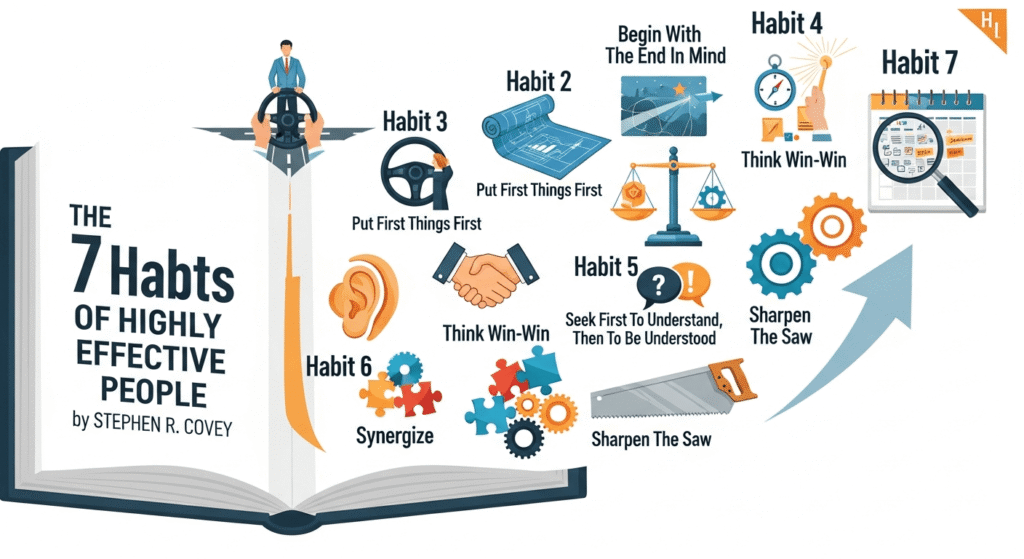
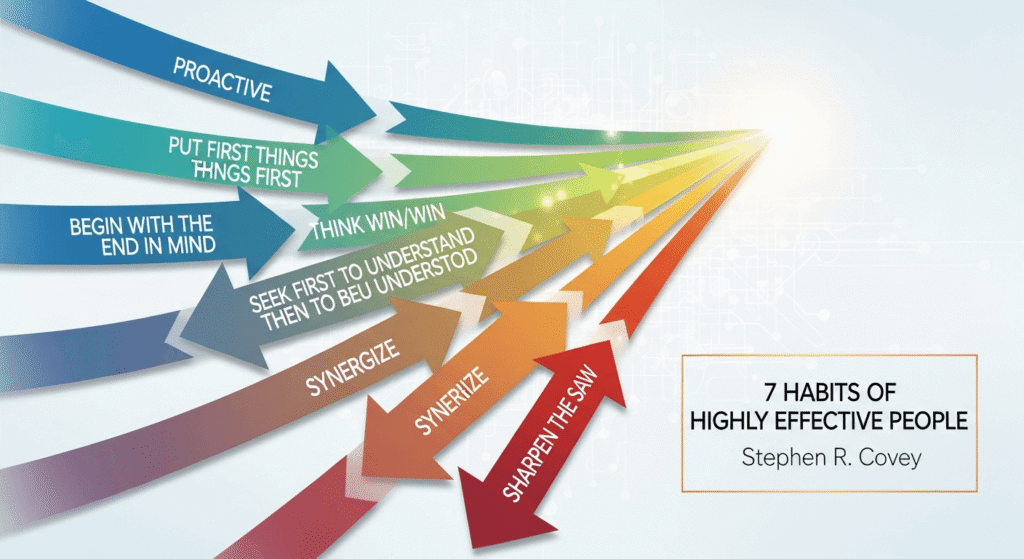
“The 7 Habits of Highly Effective People” presents a comprehensive framework for personal and interpersonal effectiveness. The book is built on the concept that true success comes from aligning our actions with timeless principles of human effectiveness.
Covey organizes the seven habits into three progressive stages. The first three habits focus on self-mastery and moving from dependence to independence. Habits four through six address interdependence and effective collaboration with others. The seventh habit focuses on continuous renewal and improvement.
The book introduces fundamental concepts like the “Character Ethic” versus “Personality Ethic,” paradigm shifts, and the “P/PC Balance” (production and production capability). Each habit builds upon the previous ones, creating an integrated approach to effectiveness.
Covey’s framework isn’t a quick fix but a journey of continuous growth. The habits require deep internal work, honest self-reflection, and consistent practice to internalize.

The first habit establishes the foundation for all others by focusing on taking responsibility for our lives. Proactive people recognize that they have the freedom to choose their response to any situation, regardless of external circumstances.
Covey introduces the concept of the “Circle of Influence” versus the “Circle of Concern.” Effective people focus their time and energy on things they can actually influence rather than worrying about things beyond their control. This shift in focus expands their influence over time.
Proactive language reflects ownership: “I can,” “I will,” “I choose,” rather than reactive phrases like “I can’t,” “I have to,” or “If only.” Our language patterns reveal and reinforce our level of proactivity.
Example: Instead of blaming traffic for being late, a proactive person leaves earlier or finds alternative routes. They focus on what they control rather than complaining about external factors.
This habit emphasizes the importance of defining clear values and goals before taking action. Covey suggests imagining your own funeral and considering what you’d want people to say about you—this exercise helps clarify what truly matters.
Every action we take is created twice: first mentally, then physically. Beginning with the end in mind means being intentional about the mental creation. Without this clarity, we may climb the ladder of success only to find it’s leaning against the wrong wall.
Covey recommends developing a personal mission statement that serves as a personal constitution. This document defines your values, principles, and long-term goals, providing a framework for making daily decisions aligned with your deepest priorities.
Example: A person might realize that family is their highest value but currently spends minimal time at home. With this clarity, they can restructure their schedule to align actions with values.
Once you know your priorities (Habit 2), Habit 3 is about executing them. This habit focuses on time management and prioritization based on importance rather than urgency. Covey introduces the Time Management Matrix with four quadrants.
Quadrant II activities—important but not urgent tasks like planning, relationship building, and prevention—are where highly effective people spend most of their time. These activities prevent crises and create long-term results.
The key is learning to say “no” to less important activities, even when they’re urgent, and “yes” to important priorities. This requires courage and the ability to live according to your values rather than reacting to external pressures.
Example: Instead of constantly firefighting, a manager schedules regular planning sessions, invests in team development, and implements preventive systems—all Quadrant II activities that reduce future crises.
This habit marks the transition from independence to interdependence. Win-Win is a mindset that seeks mutually beneficial solutions in all interactions. It’s based on the belief that there’s plenty for everyone, contrasting with the scarcity mentality of Win-Lose thinking.
Win-Win requires both courage and consideration—the balance between getting what you want and caring about what others want. It’s not compromise (which often becomes Lose-Lose) but a commitment to finding a better third alternative.
Covey explains that Win-Win agreements clarify expectations and establish mutual accountability. These agreements include desired results, guidelines, resources, accountability standards, and consequences.
Example: In a business negotiation, instead of one party trying to extract maximum value at the other’s expense, both parties work together to expand the pie and create more value for everyone involved.
This habit addresses the most important skill in interpersonal relationships: empathic listening. Most people listen with the intent to reply rather than to understand. They filter everything through their own experiences and prescribe solutions before diagnosing the problem.
Empathic listening means listening with the intent to understand the other person’s frame of reference—their thoughts, feelings, and perspective. It requires setting aside your autobiography and giving psychological air to others.
Once someone feels deeply understood, they become far more open to influence. This is why seeking to understand must come first. Then, when you seek to be understood, you can present your ideas in a way that addresses the other person’s concerns.
Example: A parent struggling with a rebellious teenager learns to listen without judgment, understanding the teen’s perspective and feelings before offering advice. This opens communication channels previously closed.
Synergy is the pinnacle of interpersonal effectiveness, where the whole becomes greater than the sum of its parts. It’s creative cooperation that produces better solutions than any individual could have created alone.
Synergy requires valuing differences rather than merely tolerating them. When we see someone who thinks differently, we can view it as a threat or as an opportunity to learn and create something new. Synergistic communication creates new alternatives.
The essence of synergy is to value differences, respect them, build on strengths, and compensate for weaknesses. It requires the security fostered by Habits 4 and 5—the Win-Win mindset and empathic communication.
Example: A diverse team combining different perspectives, skills, and experiences develops an innovative solution that no single member could have conceived independently. Each person’s unique contribution enhances the final outcome.
The final habit focuses on renewal and continuous improvement across four dimensions: physical, mental, social/emotional, and spiritual. Covey uses the metaphor of a woodcutter too busy sawing to sharpen his saw—eventually becoming less effective.
Physical renewal includes exercise, nutrition, and stress management. Mental renewal involves learning, reading, and mental stimulation. Social/emotional renewal centers on relationships and service. Spiritual renewal connects us to our values and provides perspective.
This habit makes all the other habits possible. Without renewal, we experience burnout and declining effectiveness. Regular investment in these four dimensions creates an upward spiral of growth and improvement.
Example: A busy executive schedules daily exercise, weekly reading time, regular date nights with their spouse, and daily meditation. These activities renew their capacity to be effective in all areas of life.
This book is invaluable for anyone seeking meaningful personal growth and sustainable success. Leaders and managers will find frameworks for building high-trust teams and creating organizational effectiveness.
Entrepreneurs and business professionals benefit from the principle-centered approach to decision-making, relationship building, and goal achievement. The habits provide a foundation for ethical success.
Parents and educators can apply these principles to raise responsible, capable children and create effective learning environments. The emphasis on character development is particularly relevant.
Anyone feeling stuck, unfulfilled, or seeking greater balance will find practical wisdom. The book addresses universal human concerns about meaning, relationships, and contribution.
Even skeptics of self-help literature appreciate Covey’s substantive, research-based approach. The habits are timeless principles rather than trendy techniques, making the content relevant regardless of when you read it.
The book’s greatest strength is its foundation in timeless principles rather than temporary tactics. Covey’s research-based approach provides credibility and depth that most self-help books lack.
The sequential structure of the habits creates a logical progression from dependence to independence to interdependence. Each habit builds upon previous ones, forming an integrated system of effectiveness.
Covey provides practical exercises, examples, and applications that help readers internalize concepts. The writing balances philosophical depth with actionable advice, making abstract principles concrete.
The holistic approach addresses all dimensions of life—personal, professional, relationships, and self-renewal. This comprehensiveness prevents the one-dimensional focus of many business or self-help books.
The emphasis on character and integrity resonates across cultures and time periods. Unlike trend-driven content, these principles remain relevant decades after publication.
Some readers find the book’s length and depth challenging. At nearly 400 pages with dense concepts, it requires significant time and mental investment to fully absorb.
The religious and spiritual undertones, while generally non-denominational, may not resonate with all readers. Covey’s background occasionally influences his examples and language.
Certain sections feel repetitive, particularly the extended examples and stories. Some readers wish for more concise presentation of key concepts.
The book emphasizes individual responsibility to a degree that may overlook legitimate systemic barriers and obstacles. While empowering, this perspective can seem to blame individuals for circumstances beyond their control.
Implementing the habits requires significant patience and discipline. Readers seeking quick fixes or immediate results may become frustrated with the long-term nature of the transformation process.
“The 7 Habits of Highly Effective People” deserves its status as a classic in personal development literature. Stephen Covey created a comprehensive framework that addresses the fundamental principles of human effectiveness rather than offering superficial solutions.
The book’s power lies in its principle-centered approach that remains relevant across time, cultures, and circumstances. While implementing the habits requires significant effort and patience, the potential for transformation is profound.
This isn’t a book to read once and forget—it’s a reference manual for living with integrity, building meaningful relationships, and achieving sustainable success. Each reading reveals new insights as your experience and understanding deepen.
Rating: 5/5 stars
Recommendation: Highly recommended for anyone committed to genuine personal growth. Approach it with an open mind, give yourself time to internalize the concepts, and focus on implementing one habit at a time. The investment of time and effort yields returns that compound over a lifetime.
Whether you’re a leader, parent, professional, or individual seeking greater effectiveness, these seven habits provide a roadmap for becoming your best self while contributing positively to others.